How do you ensure that everyone can truly participate, without barriers or hassle?
Leen Lambert, Dito vzw
Everyone should be able to participate, without barriers or hassle
The Testteams4ALL Toolkit
Accessibility should not be the exception. Yet people with disabilities still too often encounter obstacles in their daily lives. With the Testteams4ALL Toolkit, we want to change that. This toolkit enables people with disabilities to test for themselves how accessible buildings, locations or events are. It is a practical tool that brings together organisations, local authorities and experts by experience to improve accessibility in a structural way.
What is the Testteams4ALL Toolkit?
The toolkit was developed to encourage collaboration between people with disabilities and organisations that want to improve their accessibility. The package offers:
A step-by-step guide to setting up a test team
Tools for conducting accessibility screenings
Guidelines for formulating useful recommendations
Experts by experience make the difference
During a recent training course developed by Dito, Voorall and AFEdemy, participants with a wide range of disabilities got to work with the toolkit. Their experiences are invaluable: they recognise bottlenecks that others often overlook.
As Joanna, a member of the sounding board group, put it:
‘You see how differently people perceive things and how you complement each other. By testing together, you see more and learn more.’
Training in Brussels: learning by doing
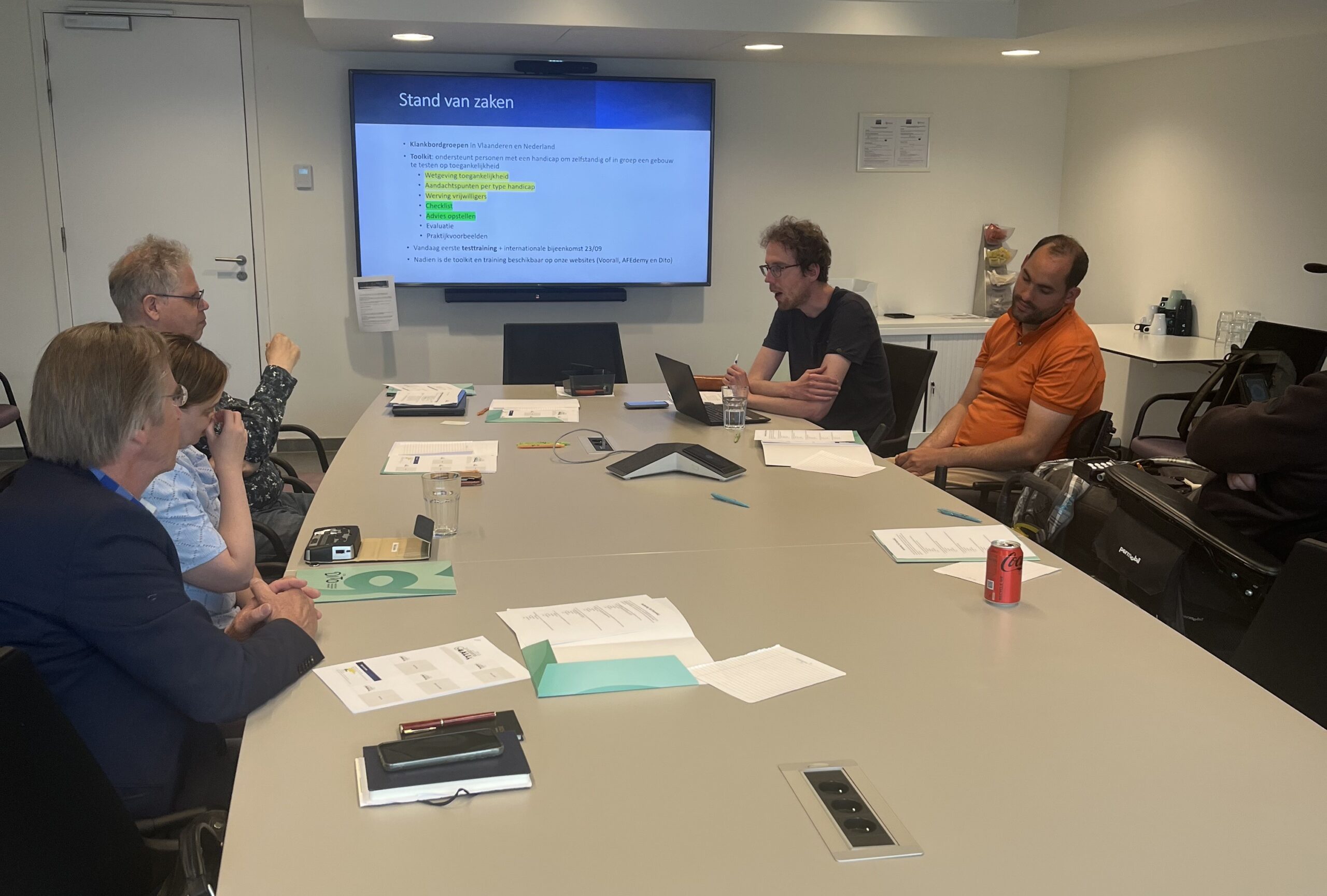
An important milestone in the project was the training in Brussels. Members of the sounding board group came together to put the toolkit into practice. Participants learned how to observe a building from different user perspectives, how to recognise and identify accessibility issues, and how to formulate constructive advice.
A powerful practical example came from Joanna van Symfoon, who is visually impaired herself. Her observations highlighted the importance of details:
‘A tactile button on a coffee machine or a printer that works without a touchscreen. It seems small, but it determines whether you can do something independently.’
No “one size fits all”
Accessibility requires customisation. Joanna emphasises that even within the visually impaired community, needs vary:
‘Some can still read well, others use Braille or speech. But one thing is universal: well-trained staff. You don’t have to arrange everything for someone, but knowing where the lift is or how to show someone around can really make a difference.’
Towards completion: September 2025
The final phase of the project is approaching. On 23 September 2025, we will organise an international meeting where we will officially present the toolkit and training, share experiences and insights from the project, and think together about the steps to be taken after the project.
The project ends in September, but we will of course continue to work on it. Accessibility requires ongoing attention and commitment. Or as Joanna powerfully summed it up:
‘Accessibility should be the norm, not the exception.’ The Testteams4ALL Toolkit brings us one step closer to that goal. Together, we can ensure that everyone can participate, without barriers or hassle.